

Range lead exposure testing is the single clearest way an indoor shooting range can prove that its air, surfaces, and employees stay within safe lead limits. Because lead dust builds up quietly behind every shot fired, operators often cannot tell by sight alone whether a range is safe. Consequently, routine testing has become a standard practice for commercial ranges, law enforcement facilities, military ranges, and private training centers that want to protect shooters, staff, and their own liability.
Quick answer: Range lead exposure testing measures airborne lead dust, surface lead residue, and sometimes blood lead levels to confirm a facility stays under OSHA’s limit of 50 micrograms per cubic meter of air. Most indoor ranges should test every six months, or more often with heavy use.
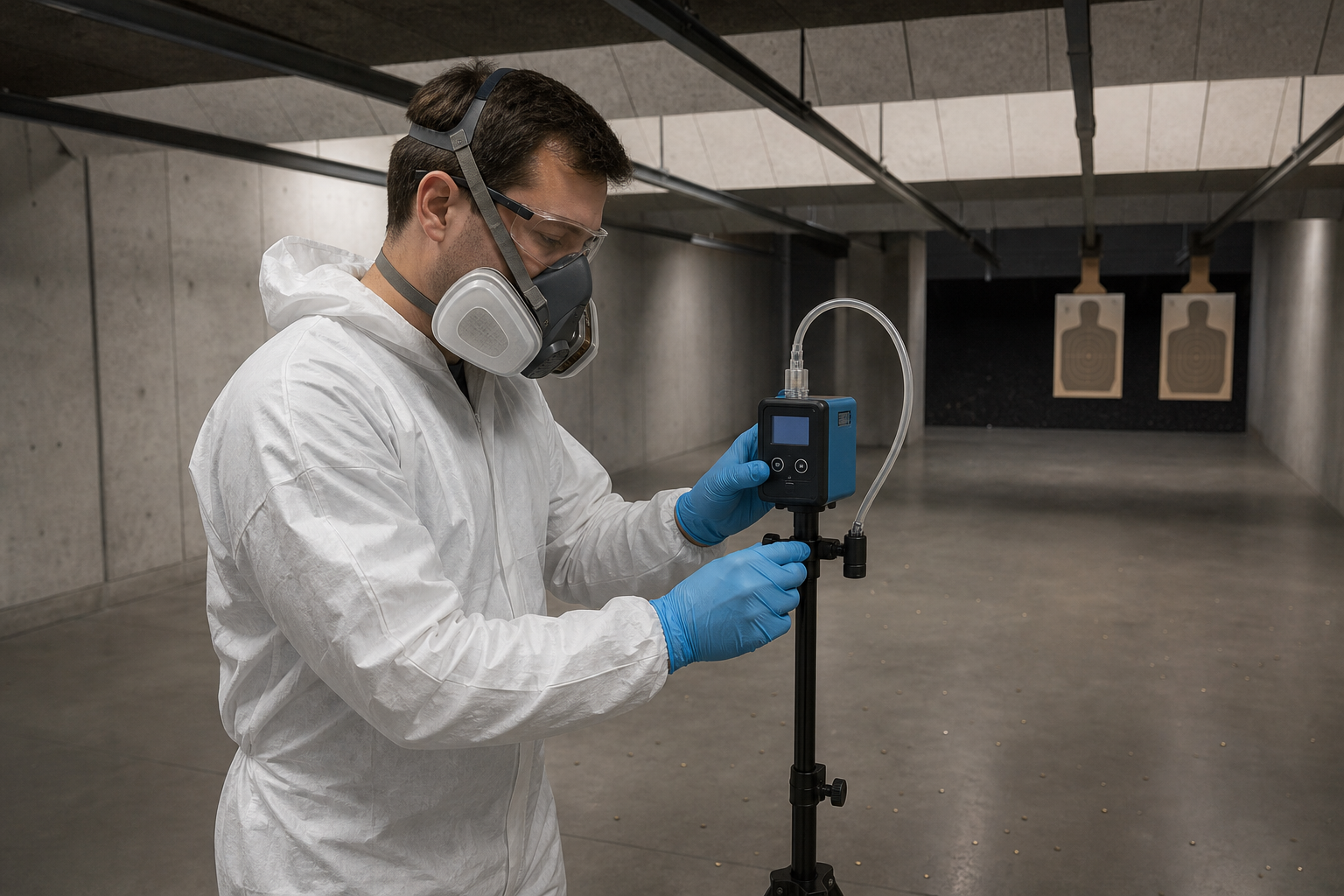
Range lead exposure testing starts with calibrated air sampling placed before shooting begins.
What Is Range Lead Exposure Testing?
Range lead exposure testing is a structured process of sampling air, surfaces, and sometimes blood to determine how much lead a person working at or visiting an indoor firing range actually encounters. In short, it turns an invisible hazard into a measurable number that can be compared against a legal limit.
Lead is a heavy metal, meaning it does not break down and can accumulate in the body over time. Firing a gun releases microscopic lead particles from primers and bullet fragments into the air, and in an enclosed range, that dust has nowhere to go unless ventilation and cleaning keep up. As a result, testing is the only reliable way to confirm whether current cleaning and ventilation practices are actually working.
Why Lead Dust Builds Up in Indoor Shooting Ranges
Every round fired leaves behind lead vapor, bullet fragments, and primer residue. Because granulated rubber backstops and steel traps are designed to catch bullets, not contain dust, lead particles settle on floors, walls, baffles, and shooters’ booths over time. In addition, foot traffic and airflow from HVAC systems can stir settled dust back into the breathing zone long after shooting stops.
Without regular range cleaning, rubber berm processing, and HEPA vacuum cleaning, dust levels climb steadily. For example, a range that skips cleaning for several months can see surface lead readings several times higher than a range cleaned on a consistent schedule. Therefore, exposure testing and physical cleaning work best as a paired routine rather than separate, occasional tasks.
OSHA and EPA Standards Behind Range Lead Exposure Testing
According to the Occupational Safety and Health Administration, the permissible exposure limit for airborne lead in general industry is 50 micrograms per cubic meter of air, averaged over an 8-hour shift. The action level, which triggers mandatory monitoring, sits at 30 micrograms per cubic meter. Since most indoor ranges operate well above that action level during normal shooting, testing is not optional for compliant facilities.
Meanwhile, the Environmental Protection Agency addresses lead contamination in soil, water, and disposal, which matters when ranges handle lead reclamation and soil remediation around outdoor berms or drainage areas. Lead poisoning itself, as described on Wikipedia’s overview of the condition, can affect the nervous system, kidneys, and blood even at relatively low chronic exposure levels, which is why testing thresholds are set conservatively.
How Range Lead Exposure Testing Works
A full testing visit generally follows a consistent sequence. Understanding each step helps range operators know what to expect and how to prepare staff and shooting schedules around it.
- Site walkthrough and baseline setup. A technician reviews ventilation, backstop type, and traffic patterns, then places calibrated air sampling pumps at fixed points before shooting begins.
- Personal air monitoring during shooting. Staff or shooters wear small sampling badges near the breathing zone while live fire continues as normal, capturing a realistic exposure picture.
- Surface wipe sampling. Benches, booths, door handles, and other touch points are wiped with lab-approved materials to measure settled dust that could transfer onto skin.
- Laboratory analysis. Filters and wipes are sent to an accredited lab, where atomic absorption spectroscopy determines the precise lead concentration in each sample.
- Reporting and recommendations. Results are compared against OSHA limits, and the final report outlines any cleaning, filter replacement, or protective equipment changes needed.
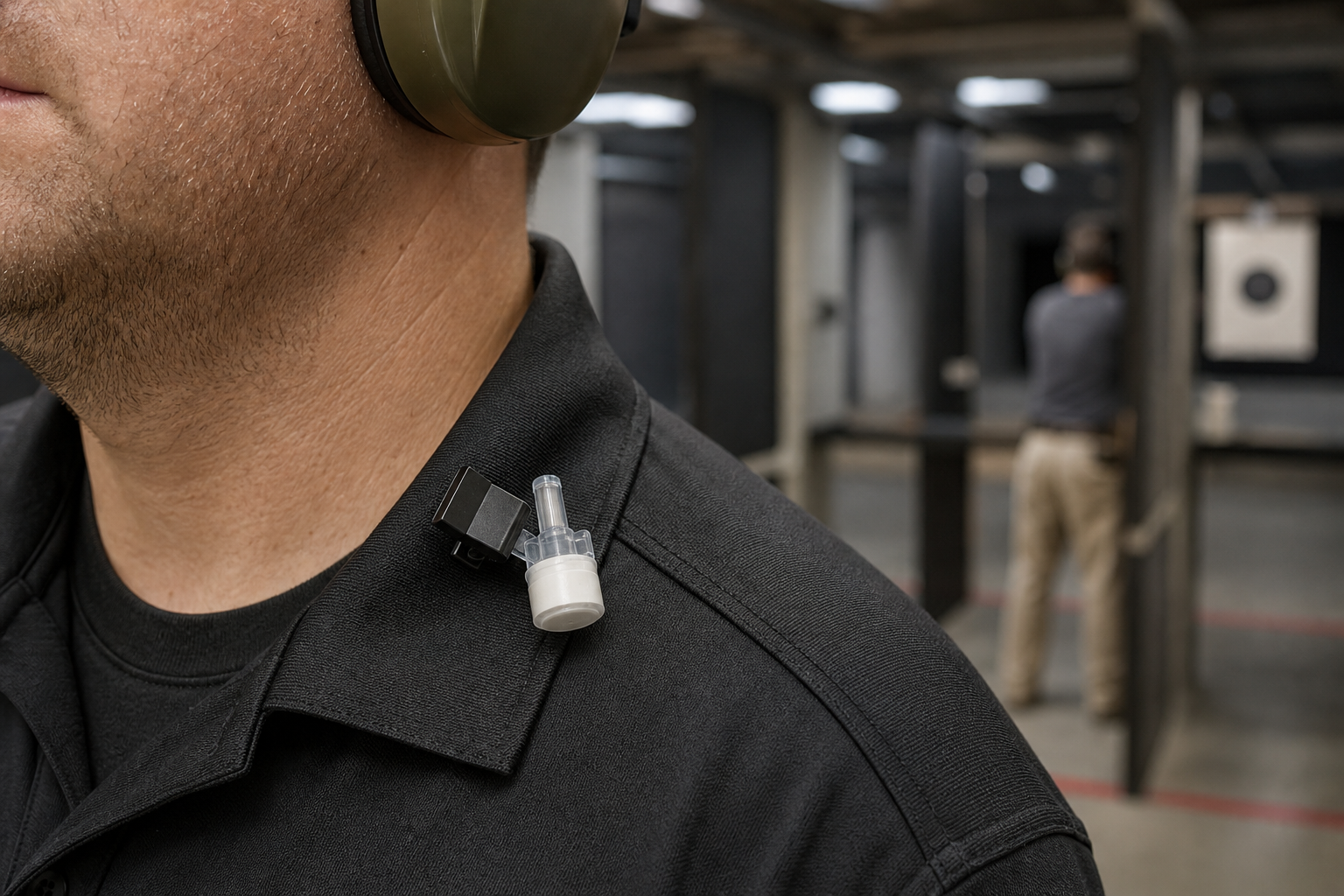
Personal badges track real-world lead exposure during a normal shift on the firing line.
Air Monitoring vs. Blood Lead Testing: What’s the Difference?
Air monitoring and blood lead testing answer two different questions, and ranges that rely on only one often miss part of the picture. Air monitoring measures how much lead is floating in the environment at the time of sampling, while blood lead testing shows how much lead has actually absorbed into a person’s body over recent weeks.
Because the two methods measure different things, a range can post a clean air sample on a slow day yet still have an employee with elevated blood lead from months of cumulative exposure. For that reason, employee lead exposure safety plans typically schedule both air monitoring and periodic blood testing for anyone who regularly works near the firing line.
| Testing Type | What It Measures | Typical Frequency |
|---|---|---|
| Air monitoring | Airborne lead dust during active shooting | Every 3 to 6 months |
| Surface wipe sampling | Settled lead dust on surfaces | Every 6 months |
| Blood lead testing | Lead absorbed into a person’s body | Annually, or more for high-exposure staff |
Signs Your Range Needs Exposure Testing Now
Certain warning signs suggest testing should happen sooner rather than on the usual schedule. Staff reporting fatigue, headaches, or metallic taste; visible dust buildup on surfaces; recent changes to trap or berm systems; and a jump in shooting volume are all reasons to move testing up. Similarly, any range that has never tested before should treat its first test as a priority baseline rather than an optional checkup.
In addition, facilities relying solely on visual cleanliness often assume they are safe simply because floors look clear. However, lead dust is microscopic, so a range can look spotless while still carrying airborne levels well above the OSHA action level.
Building an Employee Lead Exposure Safety Plan
An employee lead exposure safety plan ties testing results into daily operations instead of leaving them as a one-time report. A strong plan documents monitoring schedules, required protective equipment, hygiene stations for washing before eating or leaving the facility, and clear triggers for medical follow-up if results climb.
Furthermore, the plan should connect directly to physical cleaning routines. Rubber berm processing that separates clean rubber from lead and jacket fragments, along with scheduled rubber berm cleaning, reduces the dust available to become airborne in the first place. Likewise, timely HEPA filter, filter bag, and pre-filter replacement keeps recirculated air from quietly pushing exposure numbers upward between test cycles.
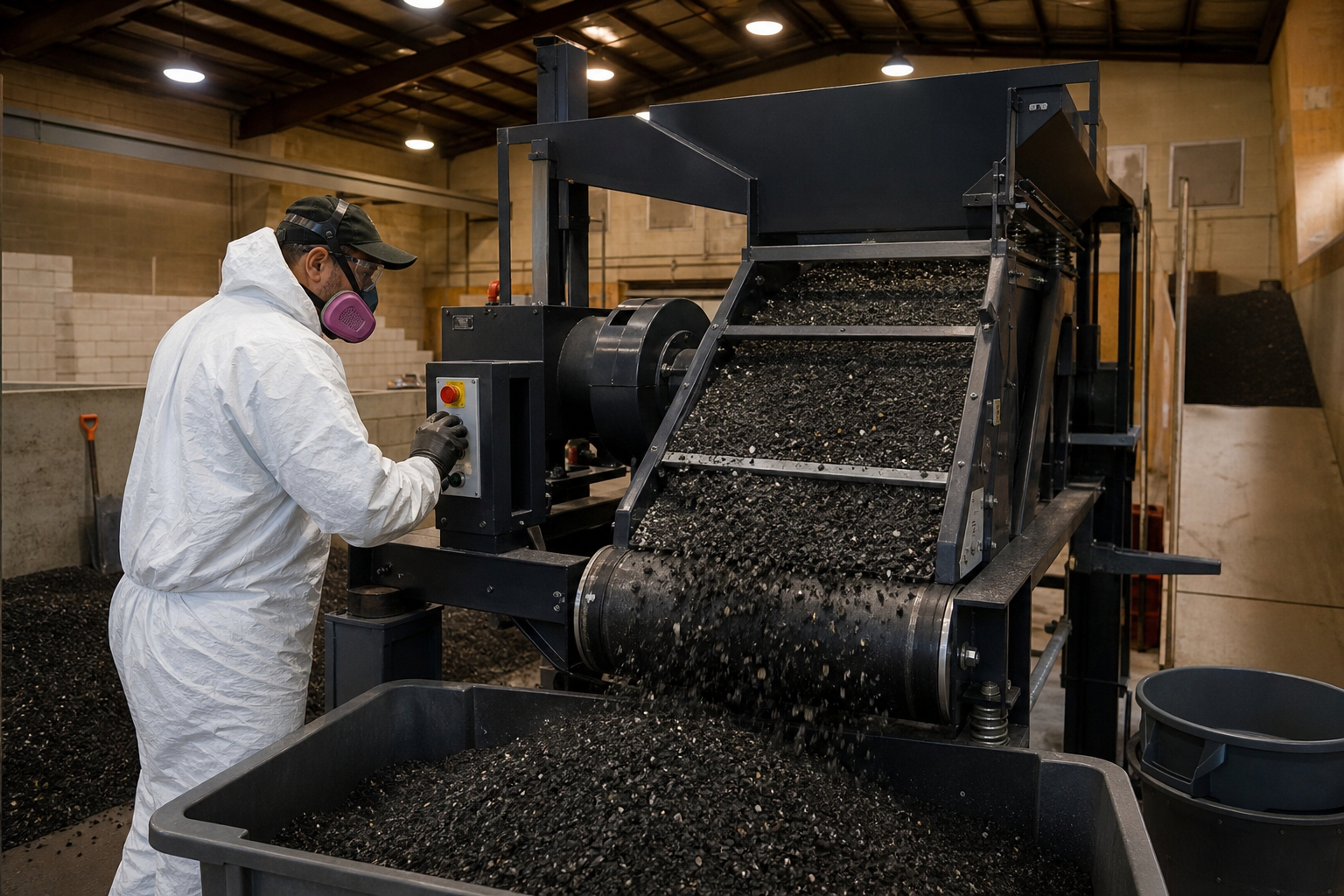
Processing the rubber berm removes lead and dust before they can become airborne again.
Choosing a Provider for Range Lead Exposure Testing
Not every environmental contractor understands the unique layout and airflow patterns of an indoor firing range. Consequently, operators should look for a provider with direct range experience, documented OSHA and EPA training, and the ability to pair testing with physical cleaning, filter replacement, and trap maintenance under one plan.
Wynant Range Consulting serves indoor rifle, pistol, and shotgun ranges across the Midwest and East Coast, including commercial ranges, law enforcement facilities, military ranges, and private training centers. Its team brings over 75 years of combined experience, offers air monitoring, exposure testing, and employee lead exposure safety plans, and pairs that work with full range cleaning services covering floors, walls, baffles, traps, and shooters’ booths. For a closer look at how the rubber berm processing machine works in practice, the team’s video library walks through the process step by step.
Frequently Asked Questions About Range Lead Exposure Testing
What is range lead exposure testing?
Range lead exposure testing is a process of measuring airborne lead dust, surface lead residue, and sometimes blood lead levels in people who work at or visit indoor firing ranges. It confirms whether lead levels stay below OSHA’s permissible exposure limit and points to areas needing cleanup.
How often should an indoor range schedule lead exposure testing?
Most indoor ranges should test air and surfaces at least every six months, with more frequent checks after heavy use, ventilation changes, or new staff hires. High-volume law enforcement and military ranges often test quarterly.
What OSHA lead standard applies to indoor shooting ranges?
OSHA’s general industry lead standard, 29 CFR 1910.1025, sets a permissible exposure limit of 50 micrograms of lead per cubic meter of air averaged over an 8-hour shift. Ranges exceeding this limit must take corrective action and increase monitoring.
How does air monitoring differ from blood lead testing?
Air monitoring measures lead dust floating in the shooting environment, while blood lead testing measures how much lead has actually entered a person’s bloodstream. Both are used together because a clean air sample does not guarantee an employee’s blood lead level is safe.
Is range lead exposure testing required by law?
Yes, OSHA requires employers to monitor employee lead exposure whenever work could reasonably expose them to levels at or above the action level of 30 micrograms per cubic meter. Indoor ranges almost always meet that threshold due to enclosed airflow.
How does rubber berm cleaning reduce lead exposure risk?
Rubber berm cleaning processes the granulated rubber backstop to separate usable rubber from lead, dust, and jacket fragments, which removes a major source of airborne and settled lead before it is disturbed again. Returning clean rubber to the trap lowers ongoing dust generation during normal shooting.
What does an employee lead exposure safety plan include?
An employee lead exposure safety plan typically includes exposure monitoring schedules, required personal protective equipment, hygiene practices, and medical surveillance triggers. It also documents training records and corrective steps if test results exceed action levels.
How long does a range lead exposure testing visit take?
A typical testing visit at a single-bay to mid-size range takes two to four hours, covering setup, sampling during active shooting, and surface wipe collection. Larger multi-lane facilities or military ranges may need a full day.
What happens if a range fails exposure testing limits?
If results exceed OSHA limits, the facility must implement engineering controls, improve housekeeping, and may need to provide respirators and medical monitoring to affected employees. Repeat testing confirms the corrective measures brought levels back into compliance.
How much does range lead exposure testing typically cost?
Costs vary by facility size, number of lanes, and whether blood lead testing is included, but most indoor ranges budget a few hundred to a few thousand dollars per testing cycle. Bundling testing with scheduled range cleaning often reduces the overall per-visit cost.
What is the difference between lead reclamation and lead exposure testing?
Lead reclamation, sometimes called indoor lead mining, physically removes and recycles spent lead from berms and traps. Lead exposure testing, in contrast, measures whether airborne or surface lead levels are safe for people, regardless of how much lead has been recovered.
Which ranges need range lead exposure testing most urgently?
Ranges with poor ventilation, infrequent cleaning schedules, high shooter volume, or staff reporting symptoms like fatigue or headaches need testing most urgently. Facilities that have never tested before or changed trap systems recently should also prioritize it.
Can poor HEPA filter maintenance affect lead exposure test results?
Yes, clogged or overdue HEPA filters, filter bags, and pre-filters let more lead dust recirculate into the shooting area, which directly raises air sampling results. Keeping filter replacement on schedule is one of the simplest ways to keep exposure test results low.
Who performs range lead exposure testing for commercial ranges?
Specialized range cleaning and safety contractors, industrial hygienists, and some EPA or OSHA-certified consultants perform this testing for commercial, law enforcement, and military ranges. Choosing a provider with range-specific experience helps ensure sampling locations and timing reflect real shooting conditions.
Final Thoughts on Range Lead Exposure Testing
Ultimately, range lead exposure testing gives operators hard numbers instead of guesswork about airborne and surface lead. Because lead exposure builds quietly and carries real health consequences, pairing regular testing with rubber berm processing, HEPA filter replacement, and steel trap maintenance offers the strongest protection for shooters and staff alike. Operators who schedule testing on a consistent calendar, rather than waiting for a problem to surface, keep their ranges safer, more compliant, and better positioned to serve commercial, law enforcement, military, and private training customers for years to come.
