
Filter bag replacement shooting range programs keep airborne lead dust and gunpowder residue out of the air that shooters, staff, and visitors breathe every day, and they form one of the most overlooked pillars of indoor range safety. Without a steady replacement schedule, the ventilation system that is supposed to protect everyone on the firing line slowly stops doing its job. This guide walks through what filter bag replacement actually involves, how it fits with rubber berm cleaning and other maintenance work, and how often a range should realistically plan for it.
Direct answer: Filter bag replacement shooting range service is the scheduled removal and replacement of pre-filters, HEPA filter bags, and HVAC media that capture airborne lead dust in an indoor firing range. It should happen on a recurring basis, typically every one to six months depending on round count, to keep lead exposure within OSHA’s limits.
What Is Filter Bag Replacement for a Shooting Range?
Filter bag replacement shooting range service is the process of swapping out the filter media inside a range’s ventilation system. These filters trap lead particulate, gunpowder soot, and jacket fragments that become airborne every time a round is fired. In particular, a high efficiency particulate air filter, commonly called a HEPA filter, is designed to capture at least 99.97 percent of particles down to 0.3 microns, according to the Wikipedia entry on HEPA filtration.
However, a HEPA filter only works as intended when the pre-filters and filter bags ahead of it are clean enough to let air move freely. As a result, replacement of all three layers together, not just the HEPA cartridge alone, is what keeps airflow and lead capture performing at the level a range depends on.
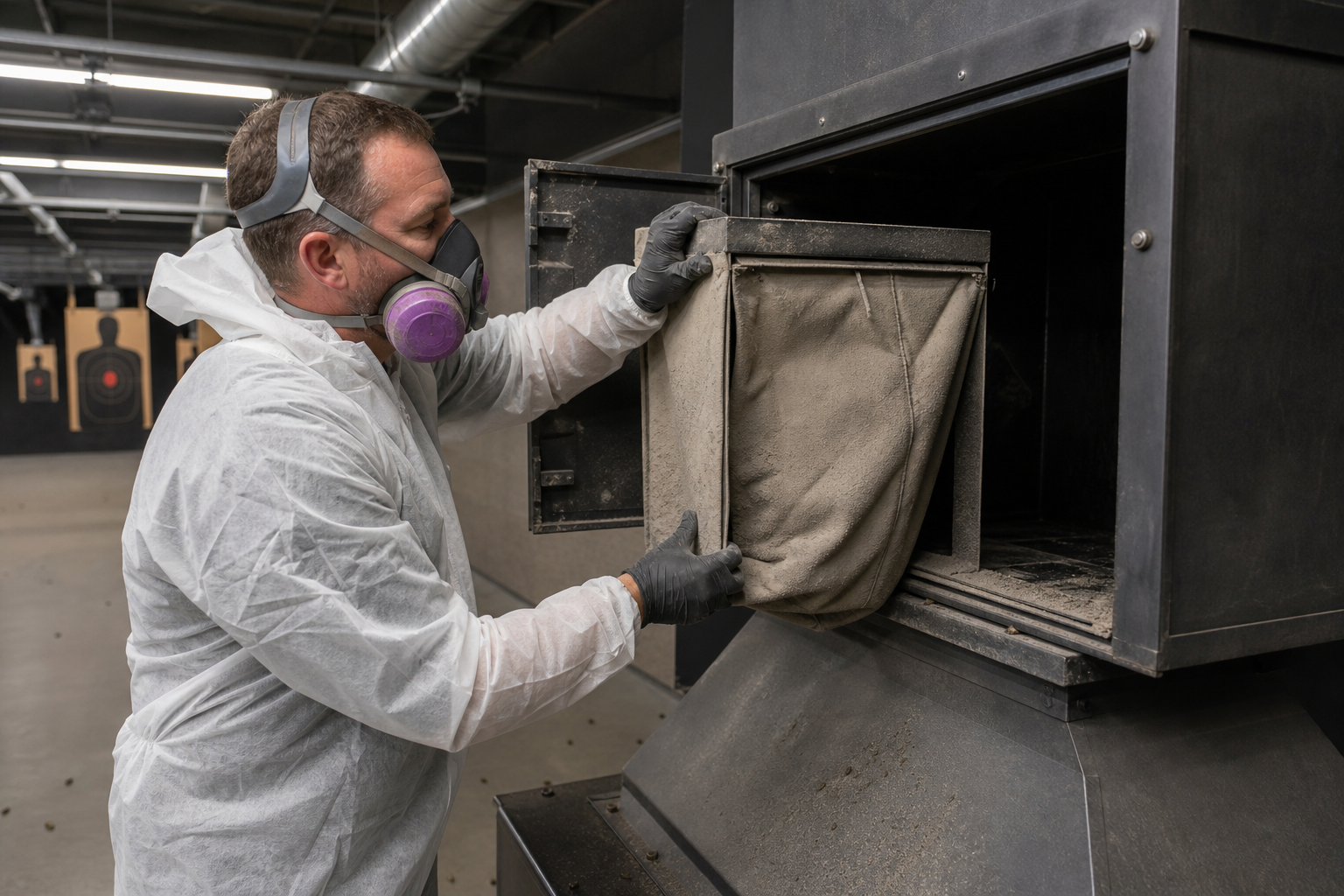
Routine filter bag replacement shooting range work requires proper PPE to avoid disturbing trapped lead dust.
Why Filter Bag Replacement Shooting Range Programs Matter
Lead exposure is a serious occupational hazard inside enclosed firing ranges. Specifically, OSHA’s general industry lead standard, 29 CFR 1910.1025, sets a permissible exposure limit of 50 micrograms of lead per cubic meter of air, averaged over an eight-hour shift, according to the Occupational Safety and Health Administration. When filter bags are clogged or overdue for replacement, airflow drops, and fine lead particulate has more time to settle on walls, floors, and shooters’ booths instead of being pulled into the filtration system.
Consequently, a neglected filter bag replacement shooting range schedule does not just hurt air quality readings. It also increases the amount of lead dust that technicians encounter later during full range cleaning, which raises both cost and exposure risk across the board. In contrast, a range that stays ahead of filter changes generally needs less aggressive deep cleaning of its floors, baffles, and trap area over time.
How Often Should Indoor Ranges Change HEPA Filters and Pre-Filters?
There is no single answer that fits every facility, because replacement frequency depends heavily on round count, range volume, and the type of backstop in use. That said, most operators find the following general intervals useful as a starting point before adjusting based on air monitoring data.
| Filter Component | Typical Interval | Why It Matters |
|---|---|---|
| Pre-filter | 1–3 months | Catches coarse debris before it reaches finer media |
| Filter bag | 2–4 months | Holds most of the lead-laden particulate load |
| HEPA filter | 4–6 months | Final stage capture of ultra-fine lead dust |
Above all, high-use ranges such as law enforcement qualification facilities should plan for the shorter end of these windows. On the other hand, lower-volume private training centers may stretch intervals slightly, provided air monitoring results stay well under OSHA’s limit.
Steps for a Safe Filter Bag Replacement Service
Replacing filters inside a lead-contaminated environment is not a simple swap-and-go task. Therefore, a trained crew generally follows a consistent sequence to protect both the technicians and the range itself.
- Shut down and isolate the affected air handling unit, then post signage and confirm the bay is clear before opening any housing.
- Put on a fitted respirator, disposable coveralls, gloves, and eye protection, since old filter bags release concentrated lead dust once disturbed.
- Remove the loaded pre-filters, filter bags, and HEPA cartridges and immediately seal each one in a labeled hazardous waste bag.
- HEPA vacuum the empty housing and nearby surfaces so residual dust is not trapped against the new filters.
- Install new filters in the correct order, restart the unit, and check a manometer or airflow gauge to confirm proper performance.
- Log the service date, filter type, and readings, then set the next scheduled replacement based on usage and prior air monitoring trends.
Signs a Range Is Overdue for Filter Bag Replacement
Several warning signs tend to show up well before a facility fails an air monitoring check. For instance, a noticeable haze or smoky smell lingering after a shooting session often points to reduced airflow. Similarly, dust settling visibly on target tracks, baffles, or the tops of shooters’ booths suggests the filtration system is no longer keeping pace with particulate load.
In addition, staff reporting headaches, metallic taste, or irritation during longer shifts can be an early indicator worth investigating through formal exposure testing. Meanwhile, a sudden spike in HVAC runtime or motor strain is a mechanical clue that filters are clogged and restricting airflow more than they should.
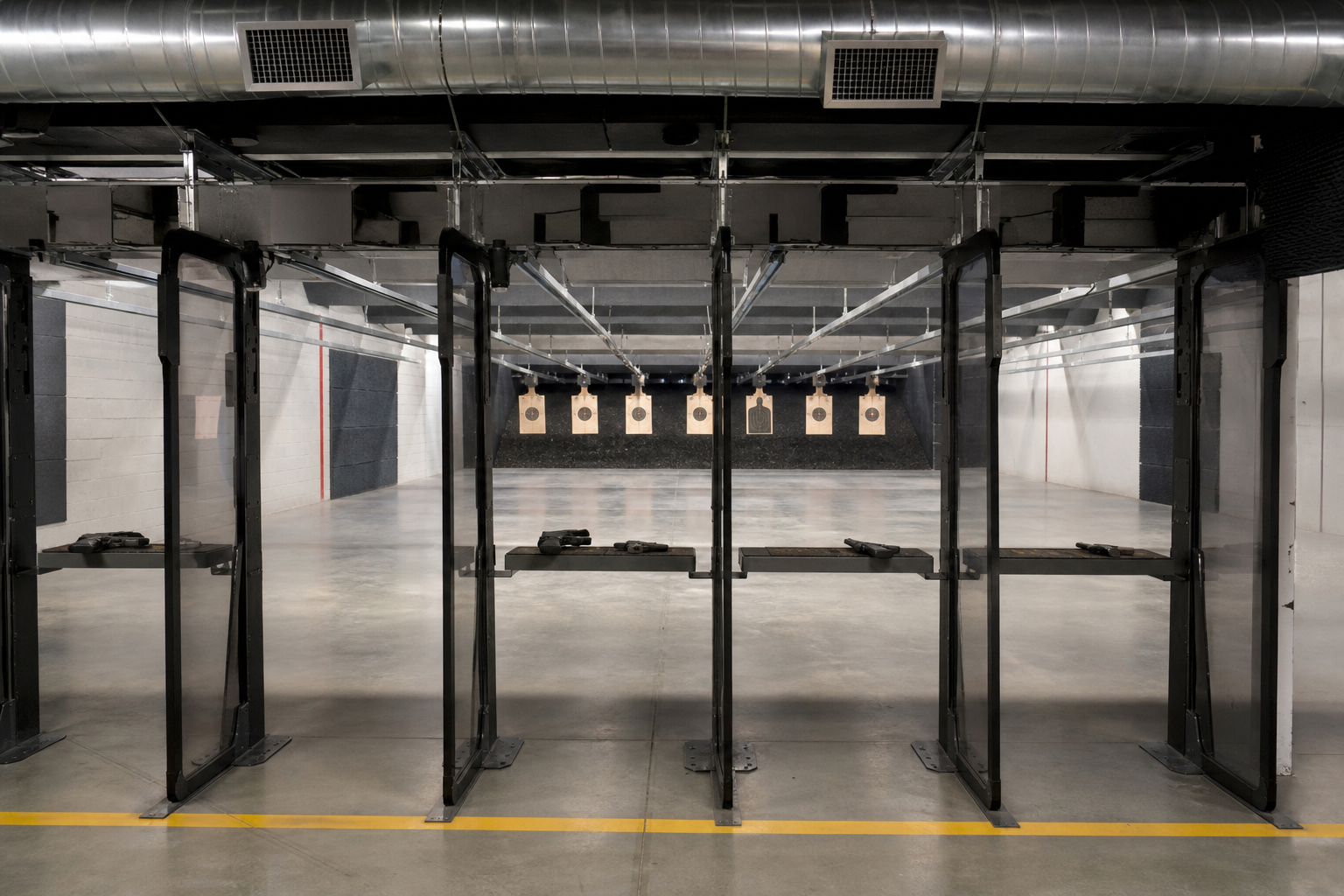
Well-maintained ductwork and filtration keep an indoor range’s air quality within safe limits.
Filter Bag Replacement vs. Rubber Berm Processing
It helps to understand that filter bag replacement and rubber berm cleaning solve two different, related problems. Filter bag replacement deals with lead dust that has already become airborne and been pulled into the HVAC system. Rubber berm processing, on the other hand, targets lead that is still embedded in the granulated rubber backstop before it ever becomes dust.
Wynant Range Consulting’s approach to rubber berm range cleaning uses a patented machine to separate usable rubber from lead, jacket fragments, and dust, then returns the clean rubber to the trap rather than most of the contaminated material. As a result, a range that combines both services tends to see fewer airborne lead spikes between filter bag replacement visits, because less contaminated material is sitting in the backstop generating dust in the first place.
Air Monitoring, Exposure Testing, and Safety Plans
Filter maintenance works hand in hand with air monitoring and exposure testing. Specifically, air sampling measures actual airborne lead concentration during live-fire sessions, which tells a facility whether its current filter bag replacement interval is actually working or needs to be tightened. The CDC’s National Institute for Occupational Safety and Health (NIOSH) notes that indoor firing ranges are a recognized source of elevated blood lead levels among frequent shooters and range staff when ventilation and housekeeping are inadequate.
For this reason, Wynant Range Consulting pairs its filter and range cleaning services with air monitoring, exposure testing, and employee lead exposure safety plans. Together, these services give range owners documented proof that their facility stays within OSHA’s permissible exposure limit, which matters for both staff safety and liability protection.
Choosing a Partner for Range Filtration Maintenance
Not every maintenance provider treats lead-contaminated filters with the same level of care. Therefore, it is worth asking a prospective vendor how they handle PPE, disposal, and documentation, not just how quickly they can finish the job. Wynant Range Consulting (WRC) serves indoor rifle, pistol, and shotgun ranges across the Midwest and East Coast, including commercial ranges, law enforcement facilities, military ranges, and private training centers.
Its team brings more than 75 years of combined experience and is trained and certified to OSHA and EPA standards, covering everything from HEPA filter and filter bag replacement to steel trap maintenance and soil remediation. Operators who want to see examples of this work in action can review the range cleaning videos or visit the Wynant Range Consulting homepage to request a service quote.
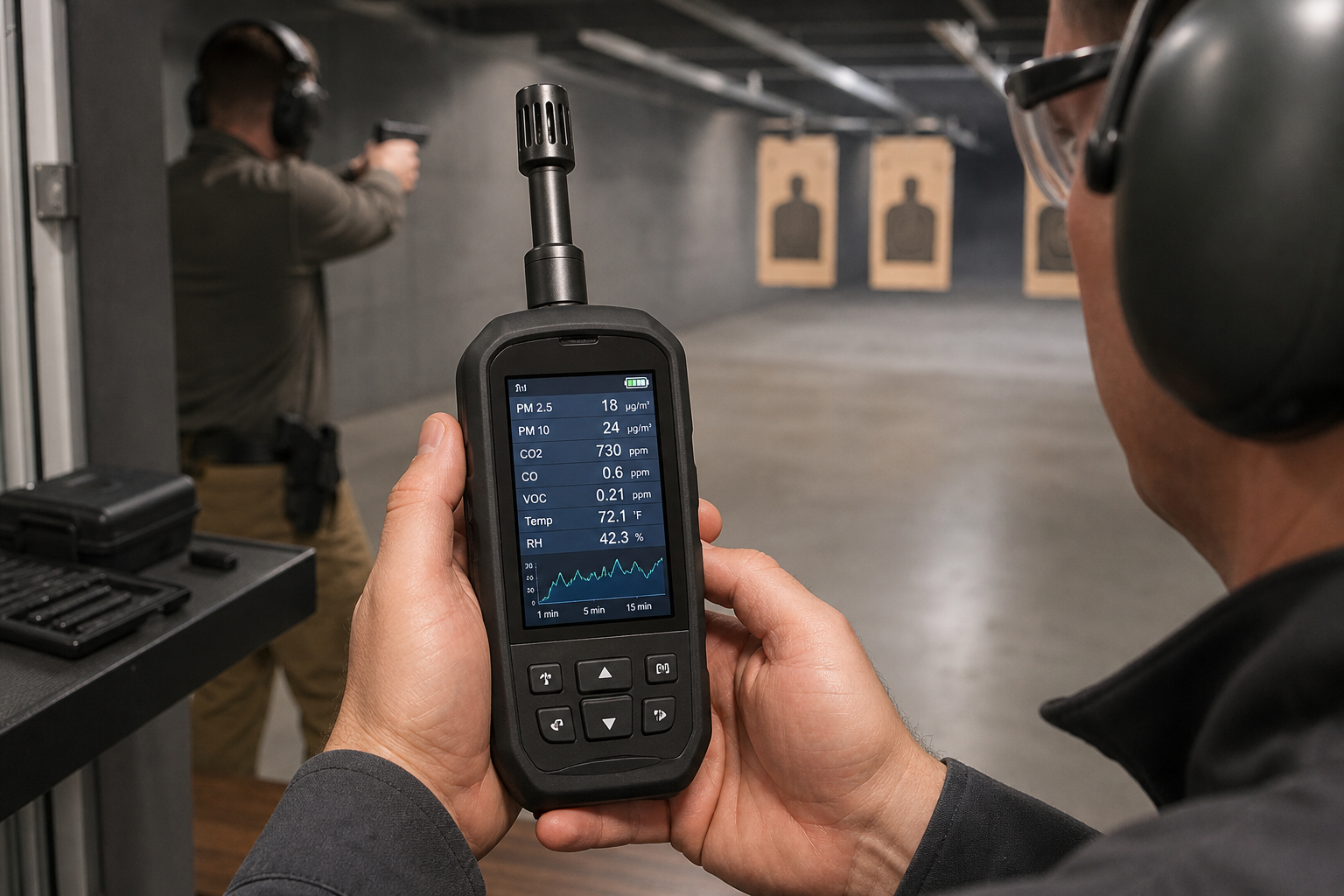
Air monitoring results help confirm whether a filter bag replacement shooting range schedule is working as intended.
Frequently Asked Questions
What is filter bag replacement for a shooting range?
Filter bag replacement shooting range service means removing lead-laden filter bags and HEPA or pre-filters from a range’s ventilation system and installing clean ones. This restores proper airflow and stops lead dust from recirculating through the shooting area.
How often should indoor ranges replace HEPA filters and filter bags?
Most indoor ranges need pre-filters checked monthly and replaced every one to three months, with HEPA filters and filter bags swapped on a quarterly to semiannual schedule depending on round count. High-volume law enforcement or training ranges often need changes more frequently.
Why does lead dust build up on filter bags so quickly?
Every shot releases fine lead particulate and jacket fragments into the air, and the ventilation system pulls that particulate through pre-filters, filter bags, and HEPA media. Consequently, the more rounds fired, the faster those filters load up and lose efficiency.
What happens if a range skips filter bag replacement?
Clogged filter bags reduce airflow, which lets lead dust settle on surfaces and linger in the breathing zone instead of being pulled out of the range. Over time this raises exposure risk for shooters and staff and can push air monitoring results above OSHA limits.
Is filter bag replacement different from rubber berm cleaning?
Yes, filter bag replacement addresses airborne lead captured by the HVAC system, while rubber berm cleaning processes the granulated rubber backstop to remove embedded bullets, lead dust, and jacket fragments. Both are part of a complete indoor range maintenance program.
How much does filter bag replacement for a shooting range cost?
Cost depends on the number of filter units, filter bag size, HVAC configuration, and how often the range is used, so a site visit is the best way to get an accurate quote. Bundling filter work with range cleaning and air monitoring often reduces the overall cost per visit.
Can staff replace filter bags themselves, or is a specialist needed?
Some ranges handle basic pre-filter swaps internally, but HEPA filter bags contain concentrated lead dust and require proper PPE, containment, and disposal as hazardous waste. Trained specialists reduce the risk of cross-contamination and keep the range compliant with OSHA and EPA rules.
What PPE is required during filter changes?
Technicians typically wear a fitted respirator, disposable coveralls, nitrile gloves, and eye protection when handling lead-contaminated filter bags. Bags should be sealed and labeled immediately to prevent dust from escaping into the work area.
How does air monitoring relate to filter maintenance?
Air monitoring measures how much airborne lead is present and helps determine whether the current filter bag replacement schedule is keeping exposure under OSHA’s permissible exposure limit. Rising air monitoring numbers usually signal that filters need attention sooner.
What areas does Wynant Range Consulting serve for filter bag replacement?
Wynant Range Consulting serves indoor rifle, pistol, and shotgun ranges across the Midwest and East Coast, including commercial ranges, law enforcement facilities, military ranges, and private training centers. The team combines over 75 years of combined experience with OSHA and EPA-trained staff.
What’s the biggest mistake ranges make with filter maintenance?
The most common mistake is waiting until airflow visibly drops or odor complaints start instead of following a set replacement calendar. By then, lead dust has often already settled across the range, walls, and shooters’ booths.
How long does a full filter bag replacement service take?
A typical service visit for a single-bay to mid-size range takes a few hours, depending on the number of filter housings and HVAC units involved. Larger multi-lane facilities with multiple air handlers may require a full day of scheduled downtime.
Do filter bags need to be disposed of as hazardous waste?
Yes, used filter bags from a lead-contaminated range generally qualify as hazardous waste and must be packaged, labeled, and disposed of or recycled according to EPA guidelines. A qualified range maintenance provider manages this chain of custody for the facility.
Final Takeaways
In summary, a reliable filter bag replacement shooting range schedule is one of the simplest ways to protect air quality, meet OSHA’s lead exposure limits, and reduce the overall lead burden a range has to manage. Above all, pairing filter maintenance with rubber berm processing, air monitoring, and a documented employee safety plan gives operators a complete picture of their facility’s lead control performance rather than a single isolated fix.
Ultimately, ranges that stay ahead of filter bag replacement tend to spend less on emergency deep cleaning and face fewer compliance surprises down the road. Facilities ready to review their current filtration schedule can reach Wynant Range Consulting at (252) 764-1809 or bwynant.roc@gmail.com, Monday through Saturday, 9 AM to 5 PM, to discuss a tailored filter bag replacement shooting range plan.
